Monday, January 19, 2009

Out in the rice fields with the ladies


The Gambian women planted their rice crops last July and with good rains they have grown very well. It is now harvest time and the women are working very hard to collect the rice for consumption. I was keen to be part of the harvest process with my Gambian friend's wife, sisters and extended family who live in a village called Sanqwia. I have met these women on a number of occasions and knew they would look after me and show me what to do.

I met them at the rice fields, following a teacher workshop I assisted with in the morning. The rice fields are close to the Gambian river, which is about 2-3km away from their homes. We then walked through mud and water up to our thighs and weaved through harvested crops to our destination. Ladies were carrying buckets on their head holding food, drink and utensils for the day.

The rice crops we were harvesting belonged to a village mid wife who freely assists ladies of the village with baby deliveries. As a thankyou for her services the village women help her with planting and harvesting. On arrival, already covered in mud, we had sour milk, sugar and dry cous cous, which has the same texture, colour and consistency as sand. I've eaten it a lot in local villages and have grown to like the taste. We got out our knives, I used my swiss army knife, arranged the 30 of us in a line and began to cut the rice, cutting the rice head and a 15cm stem. The outer stem also needed to be removed to cut down on work when it is at the pounding stage.

With my knife, I began to look for rice heads and with one hand slice the stem, remove excess growth and bundle it in my left hand. We moved forward together, ladies supporting each other to ensure all rice heads were harvested. During the harvest, the ladies sang songs together in a harmonic rhythm, I was spellbound. One lady begins and proceeds to sing a song of thanks for each of the women working, they respond with 'Abaracka, abaracka” which means thankyou. They were excited that i was helping and my Gambian name 'Aja Jawneh' was used in their song many times, I responded with 'Abaracka, abaracka'. Other songs were about Soma and their village Sanqwia.

Being out there with the ladies was truly a magical moment for me. Surrounded by huge rice fields, blue skies, palm trees, working alongside colourful dressed ladies singing in unison as they harvested rice. I really felt part of the team and was treated as such. Further afield, women in groups were also busy singing and harvesting.

The ladies look after each other, always sharing and working together. One lady walks along with a tray of cordial like drinks, whilst another shares more sour milk and cous. The rice harvested is bundled, transported to the edge of the rice fields and covered by plastic for collection. When the women have enough harvested, a donkey cart managed by children, comes along and transports the rice to the village compound. Here the rice is pounded with a large millet (like a mortar and pestle) to firstly remove the rice heads. The rice heads are then pounded to remove the outer shell. The rice is then ready to eat.

The following day when I went to visit Sanqwia and the ladies greeted me, making actions with their arms of cutting rice. Despite the language barrier, I have a strong connection with these women. Our hearts are in the right place. I look forward to a whole day in the rice fields with the ladies next weekend, 'Enshallah'. (god willing).

Tying the marriage


I was fortunate to attend the 'tying of the marriage' ceremony of my very good friend Omar Keita. I have worked closely with Omar all year, he is 33 years old and has yet to be married. This is unusual for a man of his age. Omar is such a kind and gentle man and I am very excited that he has finally found himself a wife.

I will outline the events leading up to the ceremony. Omar met his wife, Huray, whilst she was living with a friend of his over a year ago.. She worked as an Unqualified teacher for a period in our region. Omar informed his two close friends who were respected community members of his interest and his uncle who lived in his home village 200km away. It was then up to the 3 men to begin the discussions with Huray's family. They visited her family over a period of months to talk about Omar's good character and his suitability as a husband for Huray. Huray's family then discussed the proposal with Huray to see if she is willing to marry Omar. The marriage is not a forced one as Huray has a say as to whom she marries.

Omar is from the Mandinka tribe, Huray from the Fula tribe. It is common for Gambians to inter marry, although cultural traditions on either side need to be respected.

Huray's and her family agree that Omar is a worthy suitor and a day for the 'tying of the marriage' is arranged. At this stage, it is unlikely that Omar and Huray have spent time alone. On the day, our work vehicle is loaded with 5 work colleagues, Omar, his friends and uncle. All up 14 of us travel to the Fula community 3 hours away. On arrival we are greeted by the host family, as we are unable to go to Huray's family compound before the marriage is validated. At the host family we sit inside and the customary greetings and introductions are made. I am the only female, with around 12 men, but I am warmly welcomed. After the greetings and introductions we share a food bowl of sour milk and dried cous cous, this is part of the cultural ceremony.

Two religious teachers, Omar's uncle and friends representing him then walk to Huray's compound to meet with the men in her family and village, to begin the negotiations. I am unable to attend this as I am a women, but my Gambian friend goes between compounds and informs Omar and I of the proceedings. The 3 women from our village and I also make a nosy visit to see Huray, she is a lovely girl, about 19 years old. During this time period of nearly 7 hours, I sit with Omar, other women and men awaiting the outcome. Huray is able to join us towards the end, she is very excited.

The men negotiating follow the customs of greetings, introductions, discussion of Omar's character, prayers and the amount of money Omar needs to pay to the brides family to have her hand in marriage and what dowry (materials) Huray will bring with her to live with Omar. They also discuss what day Huray is able to join Omar in Soma, (4 weeks time). Once this has been agreed the exchange of Kola nuts is made as a symbol of 'tying the marriage', these are distributed to the brides friends and family. The men then return to the hosts compound and together we share two meals. One shared food bowl of rice and fish, the other of rice and goats meat. We use our right hand to eat and squish the rice together from our portion of the food bowl. Once again, I am the only female able to eat with the men.

Omar then meets Huray's family for the first time. It is well after midnight and our group says our goodbyes ,ready to make the 3 hour journey back to Soma.

From here, Omar and Huray will have wedding celebration towards the end of the year, but they are now traditionally married.

I feel extremely happy for Omar, as he is such a kind man, his wife, Huray, although much younger is a feisty and strong character, I think she will be the boss lady in their marriage, bless Omar!!

Saturday, December 20, 2008

The Gambia - The GOOD, The BAD, The UGLY


Reflecting on my time here... these are my opinions based on observations and experiences. Photos are just a beatiful mix of Gambia.

THE GOOD
  • Sharing food and materials with others.


  • Children growing up in a large, extended famiily full of love and support.


  • Children having the freedom to actively explore their surroundings, seek adventure and wander round their village knowing they are safe.


  • Children playing an important role in the functioning of the family. eg chores.


  • Stress free attitude - it will happen when it happens.


  • Welcoming family, friends and visitors and feeding/housing them for weeks on end with no fuss.


  • Being calm and relaxed when things go wrong eg. broken down bush taxi. No point in complaining if things are beyond your control.


  • Greeting people as equals on taxis, gelis, work, on the street regardless of gender, religion, ethnicity or status.


  • Honesty between peopl and acceptance of critical feedback.


  • Effective and cheap transport system.


  • Being able to buy all sorts of items through the window while waiting for a bush taxi to leave. eg. water, bananas, torches, underwear, toothpaste, DVD's, hard bolied eggs, cooked sweet potato.


  • Islmamic culture of people praying togther each day, including school children and teachers.


  • Half day Fridays due to Friday being a holy day and men go to te mosque.


  • Looking out for each other and willingness to pitch in.


  • Subsistant farming - eating what you grow.

  • Strong focus on family and not things.


  • Beautiful sunsets over the water.


  • Clear night sky with stars, moon and quiet surroundings.


THE BAD


  • Lack of planning and organisation.


  • Females expected to farm, cook, clean and raise children.


  • Skyrocketing prices of rice, resulting in families living day to day.


  • Inability for Gambia to manufacture raw materials due to standards, equipment and international monopoly of goods.


  • Bumsters annoying and hassling white coloured people.


  • Low income for workers and the inability to explore the world and get ahead, despite having a good job.


  • Limited job opportunities and further education.


  • Men sitting around and watching their wife/wives busy doing domestic chores.


  • Hot weather inland.


  • Poor roads and infrastructure.


  • Crazy bush tazi drivers on terrible roads.


  • Continual shouting of toubab by children anywhere in The Gambia.


  • Lack of water pumps in villages.


  • Electricity supply stopped in some regions due to political differences.


  • Road blocked for hours as the President travels through with motorcade.


  • THE UGLY


  • Female Genital Mutilation and the support of it from mothers.


  • Young mariage and pregnancy.


  • Old Western women travelling here to abuse their power of wealth and hook up with a young Gambian man.


  • Inability to speak your own mind publically.


  • Government control of media.


  • Tobaski Celebrations


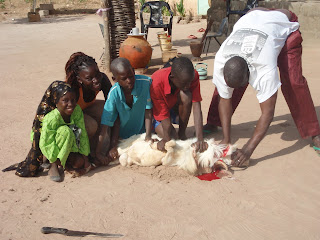
    Tobaski can be described as the Islamic Christmas, it is the biggest celebration in The Gambia. A time for families to come together and feast on mutton.
    Tobaski is based on the bible story of Abraham being asked by God to sacrifice his only son. Abraham spoke to his wife and son and all agreed his son should be sacrificed if it is God's wish. On the morning of the sacrifice, Abraham sharpened his knife to ensure the slitting of his son's throat would be swift. As he was about to kill his son, angel Gabrielle came down with a ram to kill instead. Araham and his family proved their faith in God and were rewarded with the saving of their son.

    I felt it was important that I was involved in Tobaski with my Gambian friends. Transport was difficult from the coast and I managed to get a ride on an open truck with 100 people and a few rams which were by my feet. We spent 7 hours standing going through the dry, dusty and bumpy road to Soma. I thought it was brilliant, as the people on the truck were friendly and made sure I was fine. I arrived covered in dust and had to wash my hair in a bucket a few times, but grateful I managed to get a ride back due to the friendliness of some Gambians.

    The day before Tobaski I visited families in Soma and surrounding villages, I then travelled across on the ferry and rode my motorbike to another colleagues house. Here i spent 2 nights with his family. The day of Tobaski included morning prayers where men and children go to the mosque, ladies of course are prohibited from this. I helped peel vegetables with his wife and eldest daughter.

    The family and I then spent the next hour slitting the rams throat, skinnng it, taking out its insides and cutting it up. It was a great experience and the kids loved it. What I find so beautiful is that around a fifth of the ram is given to the 'poor people'. A conversation I had with another guy at work explained that the ram meat is shared with the 'poor people' who can not afford a ram or goat, this practice is part of the islamic faith. What I found so humbling is that my work buddy is only paid $40.00 US a month, and yet what little they have they share with others less fortunate.

    I then travelled around the village with my colleague greeting people in their homes, all were involved in cooking mutton meat. I did this again in the evening with his wife. People we met spoke either Mandinka, French (as near Senegal border and Senegalese are french speaking), Wolof(another west african language) and English (to my relief).

    The rest of the day was spent sitting and watching the family grill and eat meat and conversation. Dinner consisted of shared food bowl with rams head, small intestines, meat and this dry cous cous soaked in ram meat juices. Luckily my colleague knew I don't eat red meat so I had some of the cous and potato.

    Later in the evening I rode my motorbike 5 km to meet an american friend, he was with a family too. We just hung out in a tin shed bar. As always I have another lost story...around 11.15pm, on the way back to my Gambian friend's house, which is only 2km from the seneagalise border, i got very confused. I had the right turn off but once inside all dirt streets and houses looked the same. I wasn't scared as knew I would get there eventually and asked lots of people and directions ranged from.. turn left at the mango tree, next junction right, then left etc.. Finally had to give my phone to a Gambian man who spoke to my colleague and he walked with me for 30 minutes as i putted on my motorbike. But once again, everyone very friendly and willing to help the lost 'toubab' (white person).

    Next day I rode to another gambian friends place, and sat around outside and drank more attyre while the kids all dressed up and walked around the village saying “selloboo”, this is a bit like trick or treat, the kids are given a couple of coins and they love it. Most are wearing brand new outfits and look gorgeous. All the kids around my friends house know me and call out 'Aja' (my gambian name) and some young girls just sit and hold my hand, so cute.

    'Toubab give me mintie'


    After travelling with my Gambian colleague throughout our region over the past 10 months he has finally realised that being called 'TOUBAB' can be annoying.

    To paraphrase....
    “Julie, I was thinking about how the children scream TOUBAB at you every village we travel through. Its like me be shouted 'black man' wherever I walked in Birmingham. It's not right.”


    (NO SHIT!! I thought)

    Its about time he has seen how tiring living can be in the country if you have white skin. The kids scream out toubab incessantly, it is because they are excited and generally there is no malice in it, but it feels like you are a queen , freak or an exotic zoo creature.


    To make matters worse, I have heard stories of tourists travelling in air conditioned comfort throwing sweets out the window. I blame these stupid tourists for the crap I have to put up with daily. Gambian adults find it amusing and encourage the practice.


    Which leaves me finding it a hassle to walk in any village, even my town of Soma, which is large and I don't know all the kids. My journey on foot, car or motorbike are always to the sounds of :-


    'TOUBAB give me 10 dalasi.'


    'TOUBABA give me mintie'.


    'TOUBAB, how are you?'


    or even worse..


    'TOOOOOOUUUUUUUUUUBBBBBBBBAAAAAAAABBBBBBBBBBB!!!!!!'


    A long, loud whine... ahhhh!!


    Suprisingly,I have never lost my temper and either ignore, say hello or speak in Mandinka.

    It's nice to be nice


    Bumsters are basically men aged around 17 to 35 who annoy the crap out of all white females (sometimes men too). They have their usual lines and generally make life hard because a short walk on the beach, a walk to the market, actually anywhere near the coastal area is the bumsters playground.

    Bumsters annoy all women, all ages and some try and pick up white females in the hope of getting money or a VISA. The sad and disconcerting thing is the number of older and unattractive ladies that visit The Gambia solely to have relations with a bumster. Many give the bumsters a lot of money and get caught up in this wicked love, power and money struggle. I see it daily on the coast and is uncomfortable to see a lady of 55 plus, with African beads, short skirt and sunburn walking hand in hand with a 25 year old buff fit bumster.

    In the past week on the coast I have been bumstered at least 50 times.
    Just a 30 minute walk to the bush taxi to go to work in Banjul this week has me hearing the same bumster crap.

    Some common lines, all of which I have heard this week..
    NUMBER ONE – its nice to be nice.
    Welcome to the smiling coast of Africa.
    Hey boss lady, I love you.
    Hey boss lady, where are you from?
    Excuse me, just one minute.
    Hey sister, I like the way you walk.
    Hey darling, may I walk with you.?
    Hey, you are gambian now, do you have a Gambian husband?
    Hey darling, I want to marry you, can I walk with you?
    Does your husand satsify you?
    Hey boss ladies, you are very strong/fit, can I join you? (while my friends and I go for a run we hear this at least 15 times)
    Ahh.. Australia, nice country, can you take me with you?
    How do you like the Gambia? Do you have a black husband?
    Hey boss lady, I like the way you look.
    Hey sister do you remember me? I'm Lamin from the hotel..a con used to scam money.

    Thursday, December 4, 2008

    My friends in Soma


    The pictures here are my work colleagues and their families. They are brilliant people and I love working with them. I only work with men but we have a mutual respoect for each other and enjoy having a laugh and chatting about world issues and both Australian and Gambian Culture. I do however find it difficult communicating with their wives as my Mandinka is limited and they speak little English. So my social life is mainly chatting to my work colleagues while we are at work. (which is way too many hours!!)

    Photo of lots of kids who love to greeet me when I visit my friends compound.

    My backyard in Soma


    The photos show my back yard in the wet season and as it is now.

    I have been watching the sunrise and sunset most days. The weather is a little cooler now. The rainy season has ended and the humidity is gone. Now a dry heat and I can sleep in doors comfortably. Although I have yet to use a sheet over me since I have arrived in The Gambia. I often look out at the moon and stars each night, very quiet and peaceful where i live and nothing much to do. I do work most nights though at the office, because the power is back on at 7pm after going off at 12pm.

    The two pictures show my back yard in the height of the rainy season, very green. It is now dry and the corn we planted has been picked and eaten.

    Fundraising Update


    Hello everyone,
    Thankyou for your generous donations and efforts in supporting the fundraising for 16 schools in rural Gambia. A special mention to Williamstown Primary, St Raphael's Primary and Direk PS - thanks a lot for supporting schools less fortunate than you.

    I have had a brilliant week of traveling to all the 16 schools I have worked closely with this year. I monitored the training of school staff and community members on their role as committee members in the areas of Teaching and Learning and Teacher’s Professional Development. It was great to visit these schools again, especially the remote ones which are hard to get to and chat to the staff and community members about how their school is going.

    It was very exciting to roll out phase one of our fundraising efforts with cash donations to each of the schools. $75.00/ school was handed out, which equates to 1000.00 dalasi for each school. The money was presented at the training in front of staff and community and collected by the School Community Chairperon and Principal. The Gambian like things to be done officially so many speeches were made. I spoke about what a fabulous journey the schools and I have been on over the past 9 months and the faith and belief I have the successful implementation of the Whole School Development Plan we have all worked on.

    All schools extend their sincere thanks and gratitude for the money raised and pray you have good health and happiness.

    We used the new receipt cash books, the first time a receipt has been used in schools and filled them in. The money is will be used to support the Whole School Development Plan. The School Committee can select where the money will be best spent, things like funding teacher training, teaching resources, fixing a bench, buying a tape recorder for a phonics program.

    Phase Two of the money raised in books. I have begun purchasing books for all 16 schools, thebook arebrand new and African based. I have arranged training in January for how to use picture books in the classroom and the activities that can be done. Stay tuned for that.

    If you would still like to donate, thankyou. Just give me an email and I'll send you my account number.

    The photos are of the Community Chairperson and Principal collecting the money. Thankyou again, your efforts will make a difference.


    Thursday, September 11, 2008

    Karantaba Primary School - School Mnagement Committee


    Here is one of the school's I work closely with. The photos is half of the school mamagement committee, a mixture of teachers and community members.

    Fundraising letter

    I have emailed this letter to friends and thought if anyone is following my blog and would like to donate, that would be great.
    To date, $1400 has been raised, thankyou kindly for your generous donations and efforts. A little bit of money goes such a long way in the proud schools I work with in the rural Lower River Region (LRR) in The Gambia.
    Since my last letter I have continued to work closely and form partnerships with principals and school communities in the LRR, particularly the 16 schools involved in the implementation of Whole School Development (WSD) process. WSD is a new Gambian initiative, funded by Department for International Development (DFID) and is being rolled out to all schools in The Gambia. It is an exciting time to be working here and assisting school communities in the implementation of WSD. These schools and their respective communities have been involved in intensive training in setting up committees, involving the community and students in decision making, finance training, school reviews, action plan writing and identifying school based issues. Together we have written one year development plans addressing the prioritised needs of the school. These actions will begin implementation at the commencement of the new school year, beginning on September 22nd.
    As mentioned in the previous letter, I will use your financial contributions to purchase African story books and work with cluster trainers to deliver and fund teacher training in literacy. Some of the money will also be used to support identified needs of the WSD schools, as written on their one year plans.
    Due to schools holidays and the upcoming religious celebration of Koriteh in October, I will begin school based workshops in November/December. All work being organised with schools will be captured on my blog .
    I will gratefully accept further donations until end of January to further fund school based initiatives. Please forward on this email to schools or organisations that may be willing to assist, thanks.
    Some facts:
    l School fees for one child/ year is $1.00 AUS and not all families can afford this.
    l A primary schools only source of income is student school fees. The Government does not supply additional funding.
    l Stationery materials for teachers are donated by the Red Cross and other donors, but resources are limited.
    l Generally, the only books found in schools are Gambian text books.
    l Most schools do not have enough furniture for all students to sit on.
    l Water supply to some schools does not exist due to damaged water pumps.
    l No Primary school in the Lower River Region has electricity.
    l Schools in my region have 40% of teachers who are Unqualified.
    l The Lower River Region has 52 schools. It is the poorest region and has the lowest academic results in The Gambia.
    To revisit ways you can be involved:-
    l Use me as an initial link to a Gambian school and I can provide their address and set up communication. How and what you would like to do is up to you and the Gambian school. I can support for the time I'm in The Gambia.
    l Fundraise or donate money for new books and local school initiatives. I'll provide evidence of this process on my blog through photos and written text.
    l Learn about the Gambia. For example, students may come up with a list of questions and I can interview students or teachers and email back the responses with questions for you.
    If you are willing to be involved in some way, please email me explaining your intentions and any questions you may have.
    I will respond when I have email access, usually every 2 weeks.
    If you would like to fund raise, THANKYOU! Just one donation of $15.00 can purchase a book.

    Thankyou for your support and the donations raised already, it will truly make a difference.

    Black eye


    This is what you get when you dance to the wee hours of the morning and slip face first on tiles, another proud moment!!

    Tumba fly

    3 weeks ago, I had sore appear under my arm pit. Iintially it looked like a pimple, it then began to get infected, red and pussy. I thought it may have been a boil and I tried to squeeze it, but no luck. It just grew redder and more pussy. On day 5, a pain shot through my body when the puss seemed to moved in and out. I showed some of my friends the state of my arm pit, and one thought to could be Tumba Fly maggot. I didn’t believe her as noone I had met has had one. We placed some Vaseline over the infected area as this closes up the air hole of the maggot. Sure enough, the maggot reared its little head. My three friends and all screamed!!! It was so disgusting. After many attempts, my friend managed to pull it out. I gave birth to a 1cm long, bouncing baby maggot, was a proud moment but not quite the birth delivery I had in mind.
    Tumba fly eggs land on clothes hanging outside, if they are worn immediately, they can imbed into your skin. I think I got mine from my underwear. I have photos of the maggot and will put them on in the next few weeks.

    Gambia college


    I have been teaching at Gambia Teacher’s college for the past 5 weeks. My role there has been Head of English during the summer program. During this time I have worked with fellow tutors in planning English lessons for student teachers, half of which have been teaching for one year. I emphasised the need for students to be actively involved in their learning through thinking activities, group work and literacy games. Trying to encourage teachers to move away from chalk and talk and text book based lessons.
    Classes had up to 70 students which was fine but difficult to remember individuals. I’ll be able to visit some of my students who are working in my region and support them where necessary.
    During my time at Gambia college, I was only an hour and 20min away from the coast. I commuted most days on a bush taxi to and from work. The time spent on the coast was brilliant, I was able to catch up with friends and play team sport like Frisbee and touch rugby on the beach. Life on the coast to completely different to rural life. Even though The Gambia is so small and there very few things to do, life on the coast allows you to lead an active social life with team sport and house parties, hanging out the beach was a treat (not on the sand, as I get hassled by Gambian men, locally called bumsters) and there are places to go and eat. Soma has no where to go and eat, just ladies selling food on the side of the street. But is saying this, I missed my Gambian friends in Soma and my job of going on Trek to schools and assisting my Regional team.
    Whilst teaching at Brikama, I met up with a principal, Mr Fatty, at his compound and met his first wife. I had already met and stayed in his second wife’s compound up country. Once again, I felt welcomed and met the extended family. On one occasion his compound was flooded by the rain, as seen in the photos.

    Naming Ceremony


    My colleague, Seedy Jammeh invited me to attend his daughter’s naming ceremony. This celebration is held within a year of a child’s birth. It involves the women preparing Gambian dishes for all of the guests. These are distributed in the huge shared food bowls. Family guests from the wife's side, travel far and wide to attend and money is generally donated to the family.
    Traditionally, women and men sit separately and have special duties during the celebration. Women dance and have time to go present baby clothing gifts. Following this, men sit together in a group with a Maribou spiritual leader who enthusiastically leads prayers and encourages further money donations for the family.
    Bags of popcorn and little donuts are distributed amongst the guest as little gifts.
    I knew quite a few people there including work colleagues, local teachers, Seedy’s family members and ladies I have met during my Mandinka classes I attend in the same village. The people are very friendly and welcoming, even though I stand out and get swarmed by children, I felt very comfortable sitting around and chatting.

    Saturday, June 14, 2008

    Shared Food Bowl


    Above are photos of a 'food bowl'. I have mentioned food bowl in a previous entry. Everyone in The Gambia eats from a shared food bowl at lunch and tea time, if they can afford 2 meals a day. School children eat lunch from a huge shared food bowl. The rice and oil for school children is supplied from the World Bank, called Food For Schools program. Kitchen ladies at each school prepare the food for the children each day. The Gambians use their hands for eating and share the limited meat and vegetables equally. I usually eat food bowl with a spoon when I am at schools but have recently begun to use my hand if no spoon is available. The rice and oil mixed together makes it all pretty messy. Someone in the group usually breaks off bit of meat or vegetables and places it in your side of the bowl.

    The main st in Soma


    Above are photos of the main St in Soma. I walk along this road most days. At the moment it is mango season and ladies line the streets all day selling mangoes to the gelis and people coming through. The second photo is one of the gelis that I travel to the coast on, about a 6/7 hour journey. They hold aroung 22 people. The third photo shows the food corner. This is situated by the Geli garage and people sit and have goats meat (bones and all), fried eggs, beans with a watery gravy sauce with bread for breakfast. It is a busy spot in the centre of town, my colleague and I often sit here for breakfast before we go on a long 3/4 day journey around the region.

    Thursday, May 29, 2008

    Journey back from Dakar to my town, Soma

    We did the usual bartering for cabs then another dodgy sep – place. It was hilarious watching my friends in the cab in front being chased in the garage and surrounded by Senegalise vying for our business. I hopped out of the set-place after about 3 hours travelling to go the rest of the journey alone, as i was heading straight to Soma for work the next day. I quickly farewelled my friends as they dropped me off at a dusty, busy garage full of the usual dodgy cars, people walking around selling products on their head ranging from bananas, soap, clothes, torches, underwear, sunglasses etc. I went to search for a geli going to a town in Southern senegal, this geli crosses through Soma on the way. In amongst the mayhem, a Senegalise man befriended me and showed my where to go. He was very helpful and I paid for my fare and hopped onto the geli which was a sauna filled with flies and Senegalese men, teenage boys, 2 women with their young babies. The men on this geli wore long robes, hair in long dreadlocks covered in a long material head wrap and cool sunglasses. They had on thick leather belts around their waist, army boots and necklaces showing photos of their spiritual leader. We all sat and waited for the geli to leave, we sat for 2 ¼ hours, I could feel the sweat dripping down my back and my bottom was already beginning to get sore. Finally we departed and the geli broke down after 15 minutes. After some time we set off again, there was 28 people on board and noone complained as the geli broke down 4 more times. At one point all the men got out in the sweltering heat, around 45 degrees outside and push started it. We arrived at the border, not that I was quite sure of where the border was or what it looked liked. I was asked to get out the geli by the border official and walked to the Customs building and showed my passport, praying that I wouldn't be detained due to being unsure about my visa expiry. All went well and the Senegalise official was very friendly. I filled in my details and noticed the previous entry of a Visa entry at the this small border crossing was last November! The geli waited for me and then we drove to the Gambian customs. I again was asked to get off and I showed my Gambian residence card and id card but that was not enough. My passport came out again and I walked to the Customs area. My friends had some problems at the major Gambian border recently with luggage and body searches so I was a little nervous. The Gambian official turned out to be friendly, in fact I thought he was going to ask for phone number... ahhh back in The Gambia!
    Once again the geli waited for me, I was happy to be back on Gambian soil as I have a pretty good idea as to how things operate and can get around The Gambia confidently. Signs were all now in English and money was back to dalasi. We crossed The Gambian river and I finally arrived in Soma. I started walking down the main st to toubab shouts from kids i didnt know and my work colleague rode past, we stopped and had a chat. I then heard "AJA! AJA!" another lady I knew , Isatou, called me over another chat followed. She hailed the Governor of the region driving past who gave me lift to my house. Further shouts of "Aja! Aja!"down my street ensued. 11 hours of travelling came to an end and listening to the shouts of Aja, I was finally home.

    I`sle de Gore`e


    We caught a ferry to Goree' island. This is a quiet, peaceful, small island with no cars or motorbikes. It is beautiful, like being on a Greek island in the Mediterannean, blue water, sandy coloured buildings with flowers hanging over terraces and amongst the narrow cobbled alley ways. About 1500 people live on the island. The island was once used for slave and goods trading in the 17th and 18th century and school groups and tourists visit the island due the rich history and museums. The island also has a strong arts focus with local made craft and creative artists producing colourful oil paintings.

    Dakar

    My impressions of Dakar were.. wow! A city is before my eyes, as The Gambia just doesn't have high rise buildings and only a few bitumised roads. Dakar is a city with high rise buildings, decent roads, traffic lights, round abouts and even a small garden square. The females mainly dress in beautiful, colourful West African clothing which I see everyday in The Gambia. Ladies wear a long skirt with matching fitted short sleave top and head tie. Although the females here also dress in office like clothes, but always skirts below the knee. The streets had pavers, with many markets set up sellling all sort of things, shoes, mens clothes, sunglasses etc. One thing that I found both annoying and sad about was the number of hasslers on the street trying to sell things. They wouldnt take a polite 'no merci' for an answer and we were persistently hassled, if we stopped we were swarmed. Dakar also has kids with tins walking around begging for money.The kids don't go school and collect money for their spiritual leader.
    Due the French occupation and influence, pastry shops are everywhere. I'm not really into pastries, but I couldn't find anything else to eat for breakfast, so i'm still hanging out for natural yogurt, fruit and muesli. Although, a chocolate croissant wasn't so terrible in the morning! I also ventured out to the coast for two afternoons to have a swim at a place called N'gor. On the beach I was surrounded by Senegalise kids catching the waves with me, whilst others played soccer or wrestled on the sand.
    We discovered some beautiful restaurants, we were all so excited. The nightlife in Senegal is mixed, a band playing Senegalise rhythms to a bar playing Western music from the 90's.
    One relief was not being called a Toubab, there are quite a few Western people who live in Senegal and having white skin does not seem to attract as much attention.